
What is a Shopify Loyalty Program?
(Complete Guide for 2026)
A Shopify loyalty program is a structured marketing system that rewards customers for repeated engagement with your store — most commonly through purchases, referrals, or account actions. Instead of constantly spending to acquire new customers, a loyalty program gives your existing customers a reason to keep coming back.
At its core, a Shopify loyalty program works like this: a customer makes a purchase, earns points, and redeems those points for discounts, free products, or exclusive perks. Over time, this creates a habit loop that increases purchase frequency, raises average order value, and builds a base of customers who genuinely prefer your brand over competitors.
For Shopify merchants, loyalty programs are especially powerful because Shopify’s ecosystem makes it easy to connect rewards directly to the checkout experience — meaning customers can earn and redeem points without ever leaving your store.
In short: A Shopify loyalty program turns one-time buyers into repeat customers — and repeat customers into brand advocates.


Why Do Shopify Stores Need a Loyalty Program?
Running a Shopify store in 2026 means facing rising advertising costs and increasingly competitive markets. Acquiring a new customer now costs 5 to 7 times more than retaining an existing one — yet most merchants still spend the majority of their marketing budget chasing new traffic.

A loyalty program shifts that equation. Instead of paying to win every customer from scratch, you invest in making your existing customers more valuable over time. Here is what the data shows:
• Repeat customers spend 67% more per order than first-time buyers
• Increasing customer retention by just 5% can increase profits by 25% to 95%
• Loyal customers are 5x more likely to repurchase and 4x more likely to refer friends
For Shopify merchants specifically, a loyalty program does three things that paid advertising simply cannot:
1. It compounds over time.
Every point earned is a reason for a customer to come back. Unlike an ad campaign that stops working the moment you stop paying, a loyalty program builds momentum — the longer it runs, the more valuable it becomes.
2. It turns customers into advocates.
Customers who feel rewarded are significantly more likely to refer friends and leave positive reviews. Your loyalty program becomes a word-of-mouth engine that reduces your cost per acquisition over time.
3. It gives you first-party data.
Every interaction inside your loyalty program tells you something about your customer — what they buy, how often, and what rewards motivate them. This data is invaluable for personalisation and targeted marketing.
In short: A loyalty program is not a cost — it is an investment in the customers you have already paid to acquire.

How Does a Shopify Loyalty Program Work?
A Shopify loyalty program follows a simple cycle that repeats with every customer interaction. Understanding this cycle helps you design a program that keeps customers engaged at every stage.

Step 1: Customer takes an action
The customer does something that qualifies for a reward — most commonly making a purchase. More advanced programs also reward actions like signing up for an account, referring a friend, writing a product review, or following your brand on social media.
Step 2: Points are earned
Based on the rules you set, the customer automatically earns points. For example: spend $1 = earn 1 point. The points are tracked in their account and visible every time they log in.
Step 3: Points are redeemed
Once the customer accumulates enough points, they can redeem them at checkout for a discount, a free product, free shipping, or other rewards you define. This moment — redeeming a reward — is one of the most powerful drivers of repeat purchase.
Step 4: Tiers unlock greater rewards
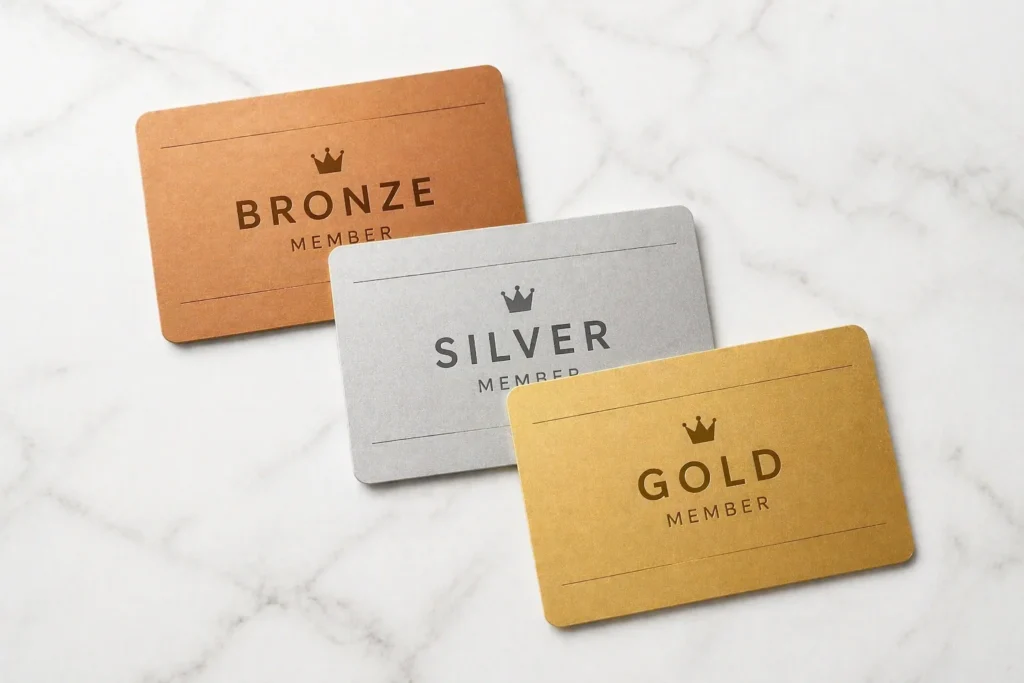
As customers spend more over time, they move up through membership tiers — for example, Bronze, Silver, and Gold. Higher tiers come with better earn rates, exclusive perks, and early access to new products. This creates an aspirational goal that motivates continued spending.
Step 5: The cycle repeats
Each redemption gives the customer a reason to come back and earn more. Over time, this cycle becomes habitual — and habitual customers are the most profitable segment any Shopify store can build.
In short: Earn points → Redeem rewards → Level up → Repeat. The longer a customer stays in the loop, the more valuable they become.
Types of Shopify Loyalty Programs
Not all loyalty programs are built the same. The right structure depends on your product type, customer behaviour, and business goals. Here are the four most common types used by Shopify merchants:

1. Points-Based Program
The most widely used loyalty structure. Customers earn points for every dollar spent and redeem those points for discounts or free products. It is simple to understand, easy to set up, and works well for stores with frequent repeat purchases — such as beauty, apparel, or consumables.
Best for: Stores with high purchase frequency
2. Tiered / VIP Membership
Customers are grouped into levels — for example Bronze, Silver, and Gold — based on their total spending. Higher tiers unlock better rewards, exclusive perks, and priority service. Tiered programs are particularly effective at motivating your best customers to spend more in order to reach or maintain their status.
Best for: Stores with a wide range of customer spending levels
3. Referral-Based Program
Customers earn rewards by referring friends to your store. When the referred friend makes their first purchase, both the referrer and the new customer receive a reward. This turns your existing customer base into an acquisition channel — reducing your cost per new customer significantly.
Best for: Stores looking to grow their customer base organically
4. Paid Membership
Customers pay a recurring fee — monthly or annually — to access exclusive benefits such as free shipping, members-only discounts, or early product access. Think of it as your own version of Amazon Prime. This model works best for stores with a highly engaged, loyal customer base that already purchases frequently.
Best for: Established stores with strong brand loyalty
In short: Most Shopify stores start with a points-based program and layer in tiers and referrals as they grow. You do not need to pick just one — the most effective programs combine multiple types.
Key Features to Look for in a Shopify Loyalty Program
Choosing the right loyalty app for your Shopify store is as important as the program itself. A poorly built app can slow down your store, confuse your customers, and create more work than it saves. Here is what to look for:
1. Flexible Points & Rewards Settings
Your loyalty app should let you control exactly how customers earn and redeem points — earn rate, redemption value, expiry dates, and minimum thresholds. Rigid systems that only offer one fixed structure will limit your ability to optimise the program over time.
2. Membership Tiers
Look for an app that supports multiple membership levels with automatic tier progression. Customers should move up automatically when they hit a spending threshold — without any manual work on your end.
3. Behaviour-Based Targeting
The best loyalty programs do not treat all customers the same. Look for an app that automatically tags customers based on their behaviour — purchased, abandoned cart, idle, high spender — so you can send the right offer to the right person at the right time.
4. Email & SMS Integration
Your loyalty program is only as effective as your ability to communicate it. Make sure the app integrates with your email or SMS platform so you can automatically notify customers about their points balance, tier upgrades, and reward availability.
5. Built-In Analytics Dashboard
You need to be able to measure what is working. Look for an app that shows you key metrics like total sales conversion rate, average daily sales amount, abandonment rate, and repeat purchase rate — broken down by customer segment.
6. Performance — No App Bloat
Every app you install adds weight to your store. A poorly built loyalty app can slow down your page load speed and hurt your conversion rate. Choose an app that is built natively for Shopify and does not require excessive third-party scripts.
In short: The best Shopify loyalty app is one that runs automatically in the background, gives you clear data, and never slows your store down.
Common Mistakes to Avoid
Most Shopify merchants launch a loyalty program with good intentions — but many make the same avoidable mistakes that limit results. Here is what to watch out for:

1. Making the rewards too complicated
If a customer cannot understand how to earn and redeem points in under 10 seconds, they will not participate. Avoid complex tier structures with too many conditions, or redemption rules that require a calculator to figure out. Simplicity drives participation.
2. Setting rewards that feel worthless
If 500 points only gets a customer $1 off, nobody will bother. Your rewards need to feel genuinely valuable. A good rule of thumb: customers should be able to earn a meaningful reward within their first two to three purchases.
3. Not promoting the program
A loyalty program that sits quietly in the background will not grow. Many merchants set it up and assume customers will find it on their own. They will not. You need to actively promote it — on your homepage, at checkout, in your post-purchase emails, and on social media.
4. Ignoring the data
Your loyalty program generates valuable data about customer behaviour — who is buying, how often, and what rewards motivate them. Merchants who ignore this data miss the opportunity to optimise their program and identify their most valuable customer segments.
5. Running too many separate apps
Many merchants run a loyalty app, a referral app, an email app, and a promotions app — all separately. This creates fragmented data, higher monthly costs, and a slower store. A single integrated platform gives you a clearer picture of what is working across your entire sales lifecycle.
In short: Keep it simple, make rewards feel valuable, promote it actively, and track your results. The merchants who do all four consistently are the ones who see compounding growth.
A loyalty program is one of the highest-ROI investments a Shopify merchant can make. Every dollar you put into rewarding existing customers compounds over time — building a base of repeat buyers who spend more, refer friends, and choose your store over competitors without needing to be convinced.
The merchants who win are not the ones with the biggest advertising budgets. They are the ones who have built a system that keeps customers coming back automatically.
SU Sales gives you everything you need to build that system — starting from $25/month.
Start building your Shopify loyalty program today.
Give your customers a reason to keep coming back — with loyalty points, membership tiers and referral rewards, all in one app.