
How to Reduce Cart Abandonment on Shopify
You worked hard to bring visitors to your store. They browsed your products, found something they liked, and added it to their cart. Then they left — without buying.
This is cart abandonment. And if you are running a Shopify store, it is happening more than you think. The good news is that it is also one of the most recoverable problems in e-commerce. With the right strategies in place, you can win back a significant portion of that lost revenue — automatically.
This guide covers everything you need to know: what cart abandonment is, why it happens, and the proven strategies Shopify merchants use to reduce it.

How to Calculate Your Cart Abandonment Rate
Your cart abandonment rate tells you what percentage of shoppers added something to their cart but left without completing a purchase. The formula is straightforward:
Cart Abandonment Rate = (1 − Completed Purchases ÷ Carts Created) × 100%
For example, if 500 customers added items to their cart and only 150 completed checkout, your cart abandonment rate is 70%.
To find this data in Shopify, go to Analytics → Reports → Online Store Conversion Rate. This gives you a funnel view from sessions all the way through to completed purchases — so you can see exactly where customers are dropping off.
As a benchmark, the global average e-commerce cart abandonment rate sits consistently above 70%. For most Shopify stores, anything below 65% is considered strong performance. If your rate is above 75%, it is a signal that something in your checkout experience — pricing, trust, or friction — needs attention.
In short: Your cart abandonment rate is one of the most important metrics in your store. It tells you not just how many sales you are losing — but how much recoverable revenue is sitting on the table.
Why Do Shopify Customers Abandon Their Carts?
Before you can fix cart abandonment, you need to understand why it happens. The reasons fall into two categories: friction and intent.
Friction is when a customer wanted to buy but something got in the way. These are the most recoverable abandonments — and the ones your strategies should prioritise.
Intent is when a customer was never fully committed to buying. They were browsing, comparing prices, or saving items for later. These are harder to recover, but not impossible with the right incentive.
Here are the most common reasons Shopify customers abandon their carts:
1. Unexpected costs at checkout
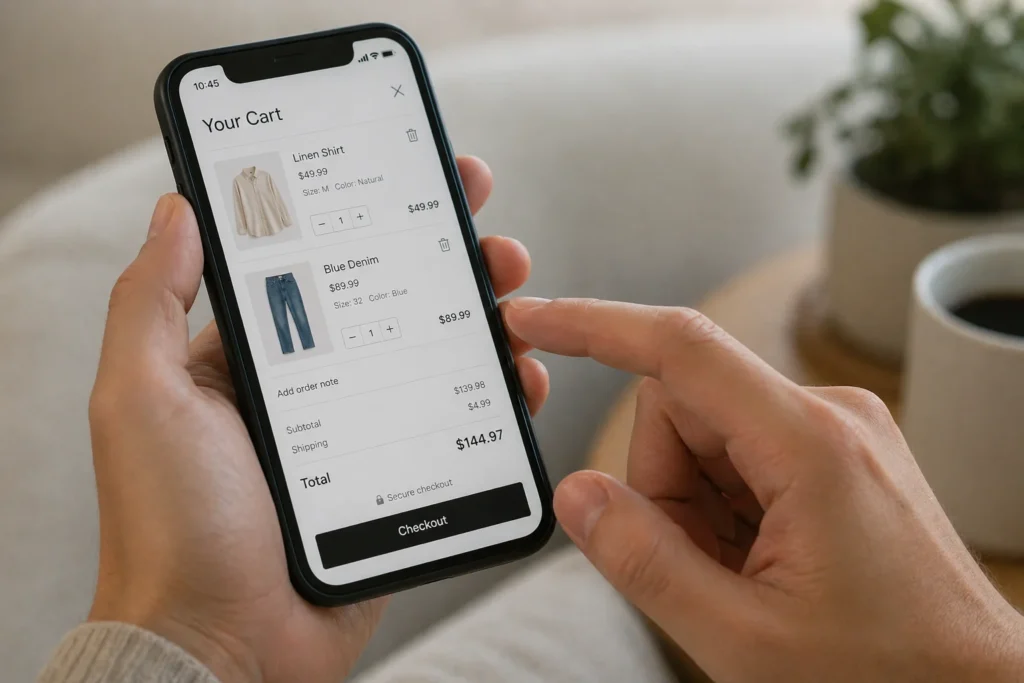
The most common reason across all e-commerce research. A customer sees a $40 product, adds it to their cart, and then discovers $15 in shipping fees at checkout. The perceived value collapses — and they leave. Showing shipping costs upfront, or offering a free shipping threshold, eliminates this surprise entirely.
2. A checkout process that is too long or complicated
Every additional step between “add to cart” and “order confirmed” is an opportunity for a customer to change their mind. Requiring account creation, asking for unnecessary information, or presenting a confusing multi-page checkout all increase abandonment.
3. No compelling reason to buy right now
Many customers abandon carts not because something went wrong, but because nothing pushed them to complete the purchase. No urgency. No incentive. No reward. Without a reason to act now, “I’ll come back later” becomes “I never came back.”
4. Lack of trust
A customer who is not confident in your store will not enter their payment details. No reviews, no return policy, no security badges — these all create doubt at the most critical moment of the purchase journey.
5. Slow page speed
A checkout page that takes more than three seconds to load loses a measurable percentage of customers. Every second of delay increases the likelihood of abandonment — particularly on mobile.
In short: Most cart abandonment is preventable. Identify which of these reasons applies most to your store, and you have already identified where to focus first.
8 Strategies to Reduce Cart Abandonment on Shopify
Now that you know why customers abandon their carts, here are the strategies that actually move the needle.
Strategy 1: Show shipping costs upfront
Do not wait until checkout to reveal shipping fees. Display estimated shipping costs on your product pages and cart page — before the customer reaches checkout. The less surprised a customer is at checkout, the more likely they are to complete the purchase.
Strategy 2: Offer a free shipping threshold
Free shipping is one of the most powerful conversion levers in e-commerce. Set a minimum order value for free shipping — for example, “Free shipping on orders over $50” — and display it prominently throughout your store. This not only reduces abandonment but also increases average order value, as customers add extra items to qualify.
Strategy 3: Simplify your checkout process
Audit your checkout flow and remove every unnecessary step. Enable Shopify’s accelerated checkout options — Shop Pay, Apple Pay, Google Pay — so returning customers can complete a purchase in seconds. Consider allowing guest checkout so first-time buyers are not forced to create an account before purchasing.
Strategy 4: Use exit-intent offers
When a customer moves their cursor toward the browser’s close button, trigger a popup with a targeted offer — a discount code, a free gift, or a reminder of what they are leaving behind. Exit-intent offers catch customers at the exact moment they are about to leave and give them one last reason to stay.
Strategy 5: Send abandoned cart recovery emails
An automated email sequence sent to customers who abandoned their cart is one of the highest-ROI tools available to Shopify merchants. The first email should go out within one hour of abandonment — while the product is still fresh in the customer’s mind. A well-timed recovery email with a clear call to action can recover 5% to 15% of abandoned carts.
Strategy 6: Use behaviour-based targeting to re-engage idle customers
Not every abandoned cart customer responds to the same message. Behaviour-based targeting lets you segment your customers automatically — identifying who abandoned their cart, who has been idle for 30 days, and who added high-value items — and send each group a personalised offer that is relevant to their specific situation.
Strategy 7: Add loyalty points as a checkout incentive
Remind customers at checkout how many points they will earn by completing their purchase. For customers who are already enrolled in your loyalty programme, this creates an additional reason to complete the order — they are not just buying a product, they are earning a reward.
Strategy 8: Build trust at checkout
Add trust signals directly on your cart and checkout pages — customer reviews, a clear return policy, secure payment badges, and a visible customer support option. Trust is the invisible barrier between a hesitant customer and a completed purchase. Remove the doubt, and the conversion follows.
In short: You do not need to implement all eight strategies at once. Start with the ones that address the most common reasons your customers are abandoning — and measure the impact before adding more.
How to Track Your Recovery Performance
Reducing cart abandonment is not a one-time fix — it is an ongoing process of testing, measuring, and optimising. To know whether your strategies are working, you need to track the right metrics.
Cart Abandonment Rate
Your baseline metric. Track this weekly to see whether your abandonment rate is trending up or down. A consistent downward trend means your checkout improvements and recovery campaigns are working.
Recovery Rate
The percentage of abandoned carts that were eventually recovered — either through a recovery email, a re-engagement campaign, or a customer returning on their own. A recovery rate of 5% to 10% is considered solid for most Shopify stores. Anything above 15% is exceptional.
Revenue Recovered
The total value of orders that were completed after an abandonment event. This is the number that matters most — it tells you in dollar terms exactly how much your recovery efforts are worth.
Email Open Rate and Click Rate
If you are running abandoned cart email sequences, track how many recipients are opening the email and clicking through to your store. A low open rate suggests your subject line needs work. A high open rate but low click rate suggests the email content or offer is not compelling enough.
The most effective way to track all of these metrics in one place is through a platform that connects your cart data, your email campaigns, and your loyalty programme — so you can see the full picture of what is working, not just isolated numbers from individual tools.
In short: If you are not tracking your recovery performance, you are optimising blind. Set your baseline, measure consistently, and let the data tell you where to focus next.
Every abandoned cart is a customer who was interested enough to act — they found your store, chose a product, and added it to their cart. That is not a cold lead. That is a warm opportunity that slipped through at the last moment.
The merchants who recover the most abandoned carts are not the ones who send the cleverest emails. They are the ones who have built a system — one that prevents abandonment where possible, recovers it automatically where it happens, and re-engages customers who go idle before they disappear for good.
SU Sales gives you everything you need to build that system — starting from $25/month.
Stop losing revenue to cart abandonment.
Recover lost sales automatically with behaviour-based targeting, re-engagement campaigns and loyalty incentives — all in one platform.