
What is a Sales Ecosystem?
(And How It Works on Shopify)
A Sales Ecosystem is a connected, automated marketing system that manages every stage of your customer journey — from the moment a visitor first discovers your store, all the way through to their second, third, and tenth purchase.
This is fundamentally different from how most Shopify merchants approach marketing. The typical store runs a collection of disconnected tools — one app for email, another for loyalty, another for discounts — each operating in isolation with its own data, its own dashboard, and its own monthly fee. The result is a fragmented customer experience and a marketing budget that never compounds.
A true Sales Ecosystem treats your entire customer lifecycle as one continuous, automated system. Every touchpoint is connected. Every action triggers the next. And the whole thing runs in the background — so your store keeps growing, even when you are not watching.
In short: A Sales Ecosystem is not a single tool or tactic. It is the complete infrastructure that turns strangers into customers, customers into loyal advocates, and advocates into your most powerful acquisition channel.

Why Most Shopify Stores Struggle to Grow
Most Shopify merchants are working harder than they need to — and getting less than they should in return. The problem is rarely the product. It is the infrastructure behind the store.
Here is what a typical Shopify marketing stack looks like in practice:
- A loyalty app that has no idea what your email platform is doing
- A referral app that cannot see your discount rules
- An analytics dashboard that only tracks what happens inside its own tool
- An email platform that does not know which customers have already redeemed a reward
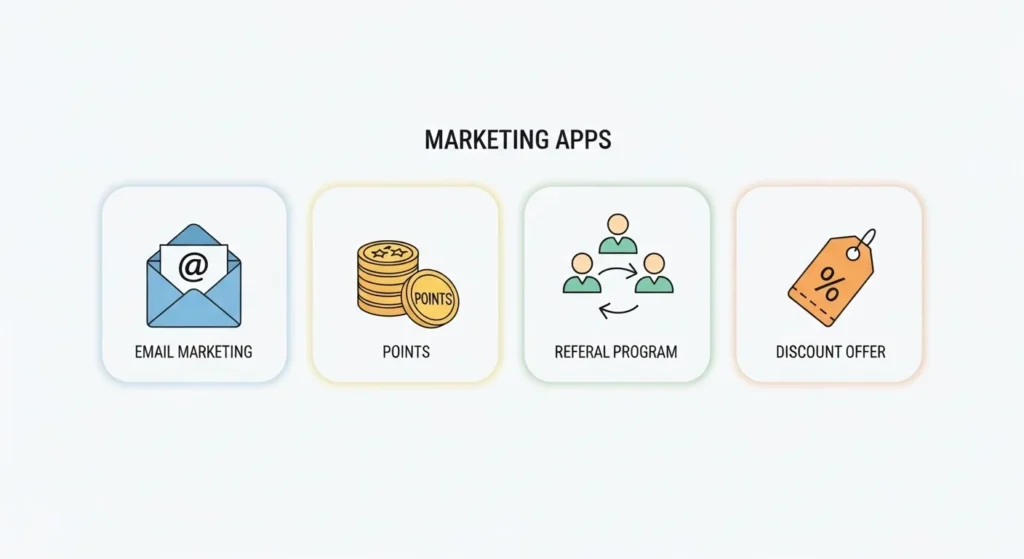
Each tool does its job in isolation. But none of them talk to each other — and that silence is expensive.
1. Fragmented data
When every app has its own dashboard, you never get a complete picture of your customer. You know how many points were issued, but not whether those customers actually came back. You know your email open rate, but not whether the recipients converted. Without unified data, every marketing decision is based on incomplete information.
2. Compounding costs
The average Shopify store running a full marketing stack pays for five to eight separate apps. Each one adds to the monthly bill — and none of them deliver the full picture on their own. As your store grows, so does the cost of maintaining this fragmented infrastructure.
3. A slower store
Every app you install adds code to your storefront. Too many apps mean slower page load speeds — and slower pages mean lower conversion rates. Studies consistently show that a one-second delay in page load time can reduce conversions by up to 7%.
In short: The reason most Shopify stores plateau is not a lack of effort — it is a lack of connection between the tools they are already using.

The 4 Processes of a Sales Ecosystem
A complete Sales Ecosystem is built around four processes — each one targeting a different stage of your customer journey. You do not need to implement all four at once. Most merchants start with the process that addresses their most pressing challenge and expand from there.
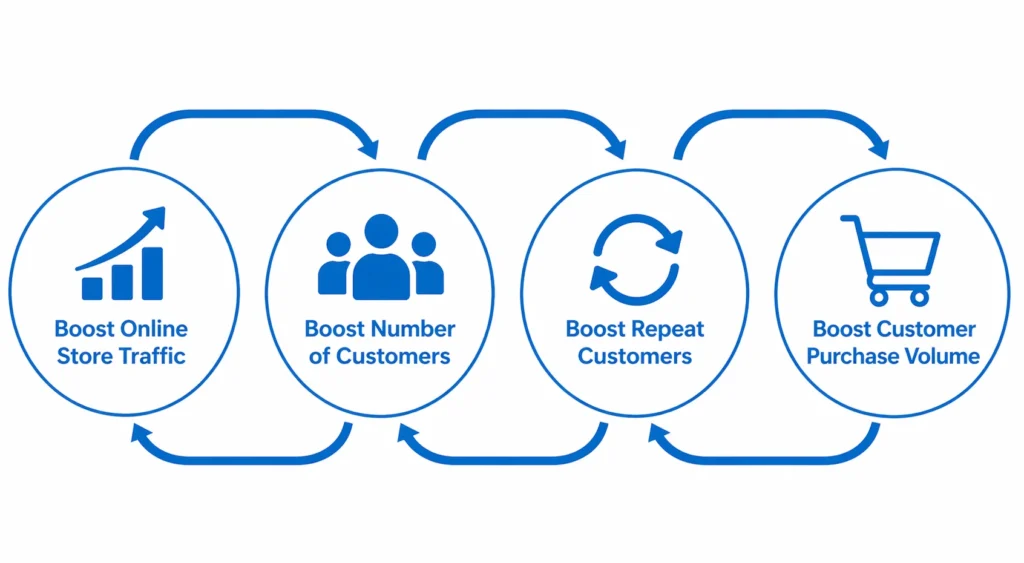
Process 1 — Boost Online Store Traffic
Converting social media viewers into paying customers. Most Shopify stores spend heavily on social media advertising — but lose the majority of that traffic because the path from ad to purchase is too long and too complicated. This process shortens that path with a Fast Buy Page — a streamlined, one-click purchase experience built specifically for social media traffic — combined with targeted instant discounts that give first-time visitors a reason to buy right now.
Process 2 — Boost Number of Customers
Turning your existing customers into an acquisition channel. Instead of paying for every new customer through advertising, a referral programme rewards your loyal buyers for sharing your store with friends. When the referred friend makes their first purchase, both parties receive a reward — creating a dual incentive that drives registrations and first purchases simultaneously.
Process 3 — Boost Repeat Customers
Keeping the customers you have already acquired coming back. Using behaviour-based targeting, this process automatically identifies customers who have abandoned their cart, gone idle, or reached a new spending milestone — and sends them a personalised offer at exactly the right moment. Combined with a loyalty points system and membership tiers, it transforms one-time buyers into habitual customers.
Process 4 — Boost Customer Purchase Volume
Increasing how much each customer spends per order. Through smart promotions — volume discounts, spend-threshold rewards, bonus points multipliers, and free gifts — customers are incentivised to add more to their cart before checking out, raising your average order value without requiring more traffic or more customers.
In short: Each process solves a different growth problem. Use one, use all four, or start anywhere — a Sales Ecosystem works however your business needs it to.
How the 4 Processes Work Together
While each process can operate independently, the real power of a Sales Ecosystem comes from running them together. When all four processes are connected, every customer interaction feeds the next — creating a compounding growth loop that gets stronger over time.


Here is what that looks like in practice:
A customer discovers your store and lands on your Fast Buy Page — Process 1 in action. They make their first purchase and are automatically enrolled in your loyalty points system — Process 3 kicks in. A few days later, they receive a personalised email reminding them that they have points ready to redeem — bringing them back for a second purchase.
On their second visit, they see a volume discount offer — Process 4 — and add two extra items to their cart to unlock a free gift. Delighted with the experience, they share their referral link with a friend — Process 2 — who signs up and makes their first purchase, earning both of them a reward.
That friend then enters the same ecosystem. And the cycle repeats.
This is the fundamental difference between running disconnected marketing tools and running a Sales Ecosystem. Individual tools optimise for single moments. A Sales Ecosystem optimises for the entire customer lifetime.
In short: One customer's journey through all four processes can generate multiple purchases, a referral, and a new customer — all automatically, without any additional ad spend.
How to Build a Sales Ecosystem on Shopify
Building a Sales Ecosystem does not mean overhauling your entire marketing stack overnight. The most effective approach is to start with your biggest gap and expand systematically from there.
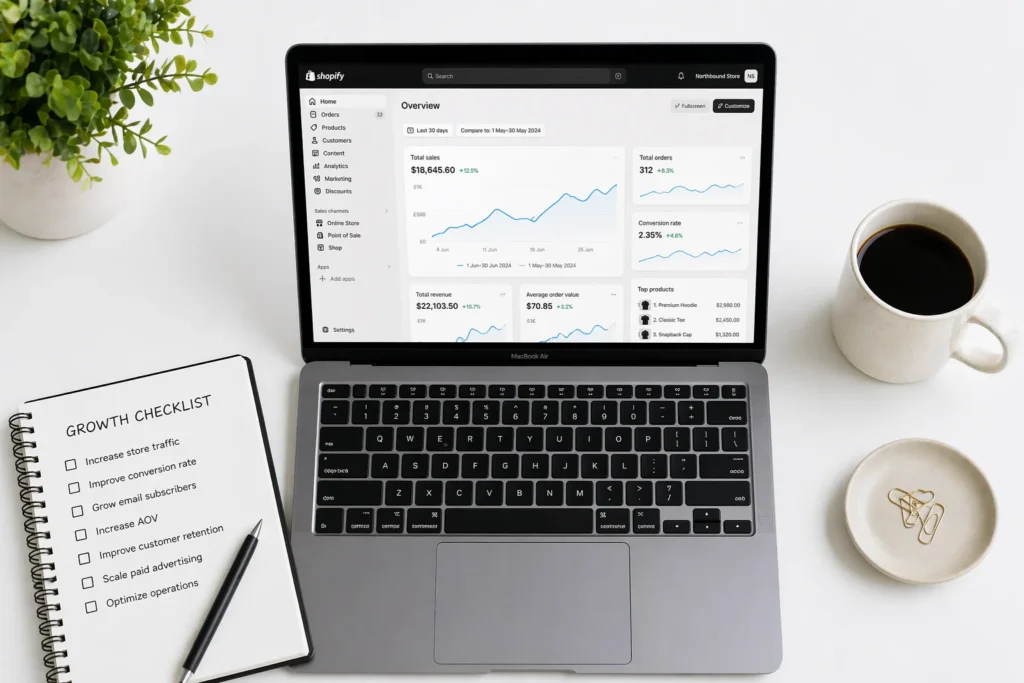
Step 1: Audit your current customer journey
Before adding anything new, map out what your customer experience actually looks like today. Where do most visitors drop off? Are existing customers coming back for a second purchase? Are you losing revenue at checkout? Identifying your weakest point tells you exactly which process to prioritise first.
Step 2: Identify the gaps
Once you have mapped the journey, look for the moments where customers are falling through the cracks — a visitor who never converts, a first-time buyer who never returns, a loyal customer who has no reason to spend more. Each gap corresponds directly to one of the four processes.
Step 3: Choose an integrated platform
This is the most important decision. You can piece together a Sales Ecosystem using multiple separate apps — but as we covered earlier, that approach creates fragmented data, stacking costs, and App Bloat. An integrated platform that covers all four processes in one place gives you a cleaner, faster, and more measurable system from day one.
Step 4: Set up each process systematically
Start with the process that addresses your most pressing problem. Get it running, measure the results, then layer in the next process. You do not need all four active at once — a Sales Ecosystem is designed to grow with your business.
Step 5: Measure and optimise
Once your processes are live, review your core metrics regularly. Which process is driving the most revenue? Where are customers dropping off? Use the data to refine your reward structures, adjust your targeting, and improve your offers over time.
In short: Start with your biggest gap. Fix it. Measure it. Then expand. A Sales Ecosystem is not built in a day — but every process you add makes the whole system more powerful.
A Sales Ecosystem is not a luxury reserved for large brands with big budgets. It is the most efficient way for any Shopify merchant to grow — because it makes every customer more valuable, automatically.
SU Sales gives you all four processes in one platform — traffic, referrals, loyalty, and promotions — starting from $25/month. No fragmented tools. No stacking costs. Just one connected system that runs on autopilot and gets stronger the longer it runs.
Build your Sales Ecosystem on Shopify today
Connect all four processes in one platform — traffic, referrals, loyalty and promotions — and let your store grow on autopilot.